

SR-041Probiotic Assay · Solution Prep & MeasurementLive · 4 cameras
Rec
Rec
Rec
Rec
A living record of experiments, labs, and research activity, built for the human researcher.
Coming soon
An independent wet-lab studying microbial resilience and the procedural substrate of experiments themselves. Every run is recorded, hashed, and openly reviewable.
Members
6
Experiments
3
Files
58
Datasets
4
Downloads
12.4k
Arche Assistant
LiveCreate your own lab to store materials and artifacts, launch real-world experiments observed and assisted by Arche Vision, and invite collaborators.
Microtubule coherence assay
Arche Vision
Arche Vision connects your real-world experiments to your Arche Labs. Set up your experiment like you normally would, position a camera so Arche can see everything clearly, provide some context, and embark.
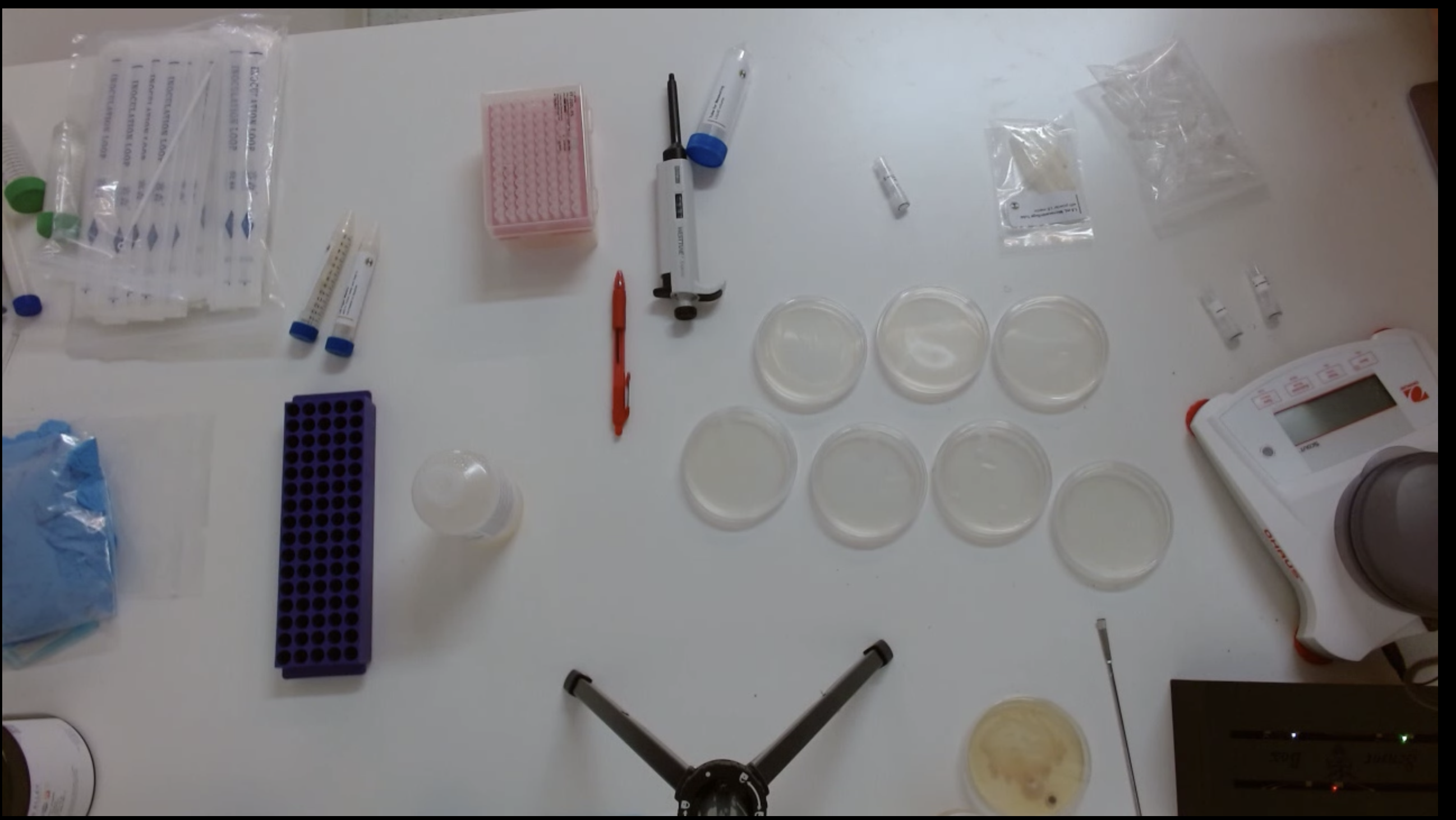
From a bird's-eye view, Arche predictively documents every step you complete inside the camera frame, and identifies deviations, potential errors, and maintains context awareness. At the end of the experiment you'll have a full video record with the lab logs and associated files that you can share for collaboration.
You can use any ordinary camera for Arche to work — a smartphone, webcam, digital camera, and more. Optionally, you can also use our 'Sensor Box' device that records metadata like temperature, pressure, and humidity for further awareness.
When the run ends, you keep a complete, verifiable record — event logs, sensor data, context, files, and video — held privately or shared openly for anyone to review.
Quantum Consciousness Lab · Jun 15, 2026
48:27
Duration
1,204
Lab logs
16
Objects
3
Files
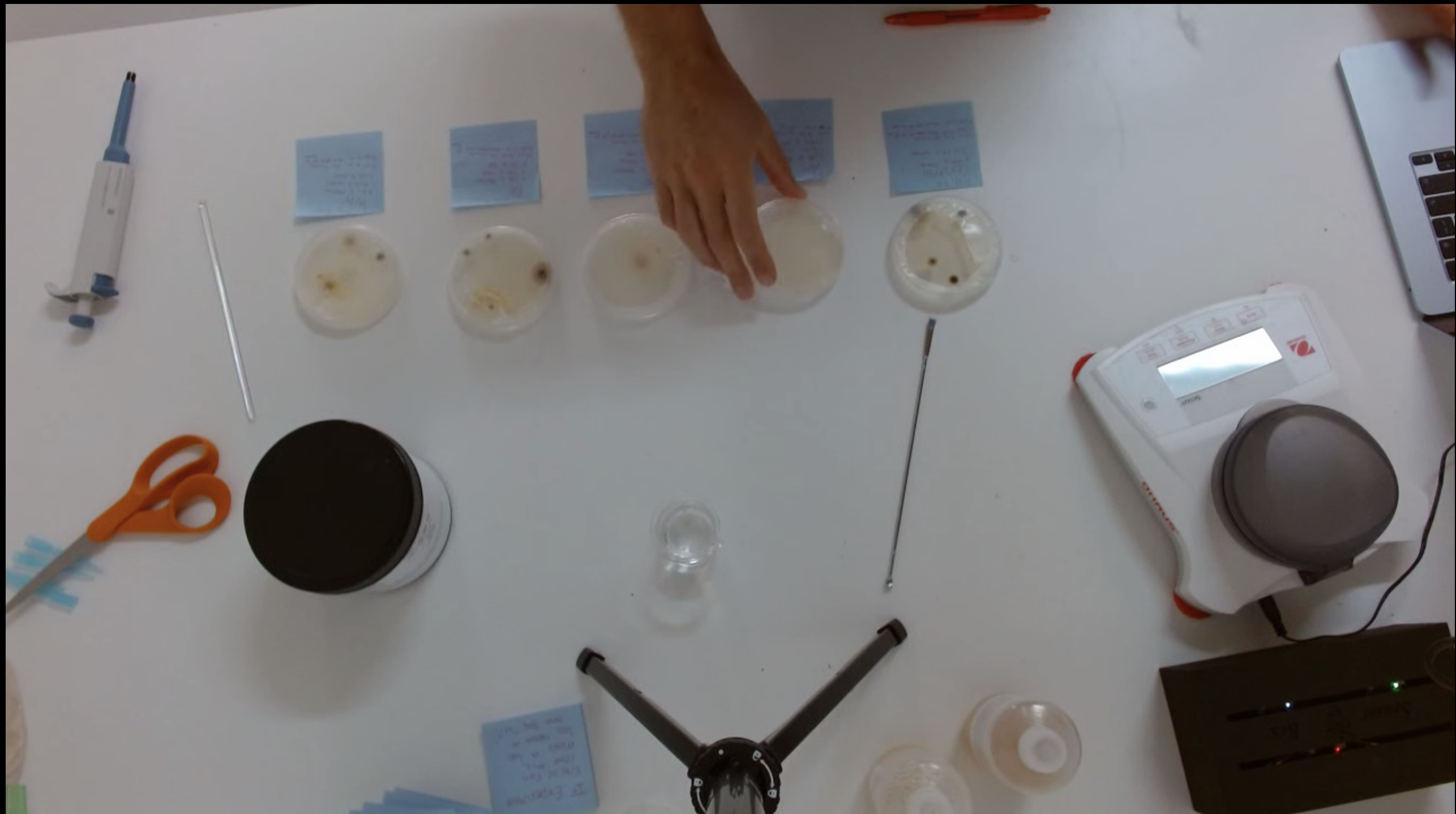 Captured video · 48:2741 segments
Procedure executed across three stabilization cycles. Reagent transfers and incubation intervals matched the declared protocol; coherence signal held above baseline for 34 minutes.
Possible deviation — sample left uncovered for 2m 10s at 00:19:42.
Arche Labs
Organize research artifacts, launch experiments, invite collaborators. Labs can be made public for open-source science, or kept private.
@velelse · @kaonic · @m.reyes
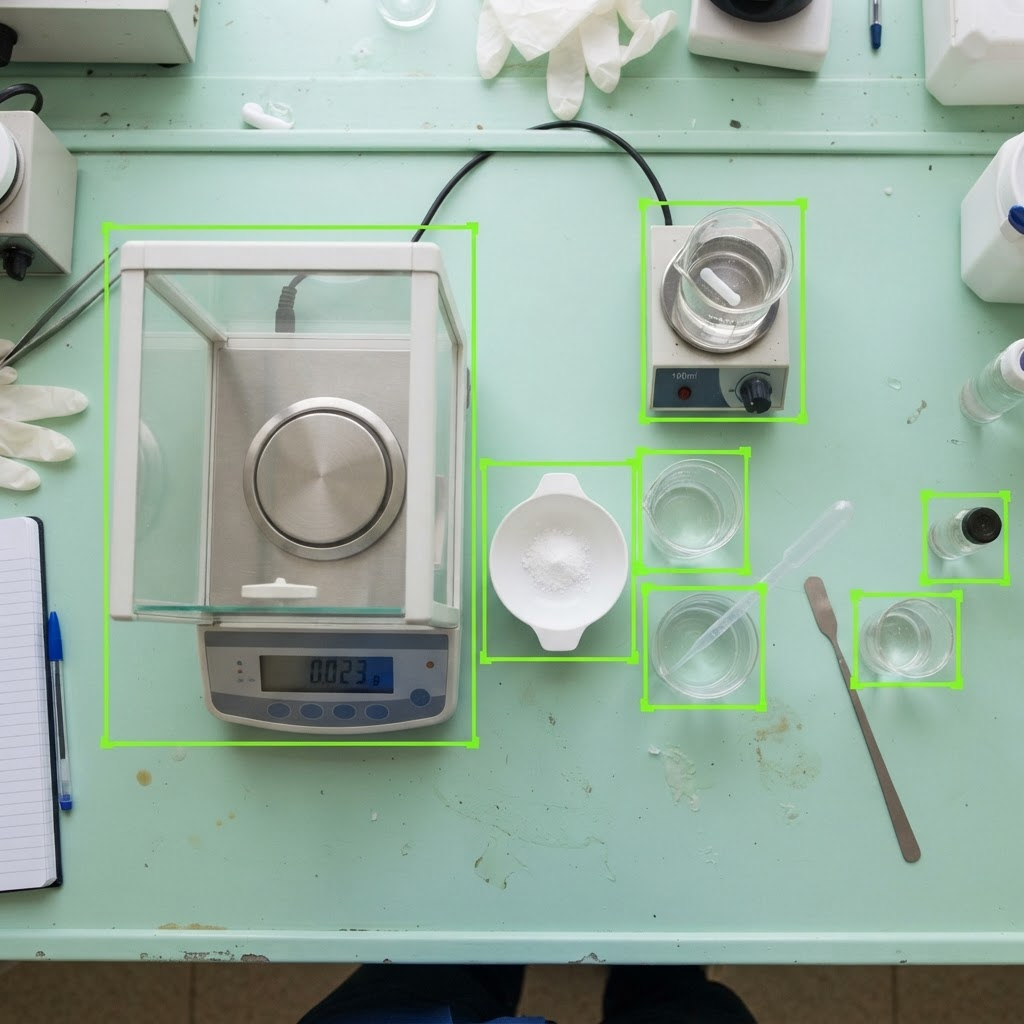
Microtubule coherence assay
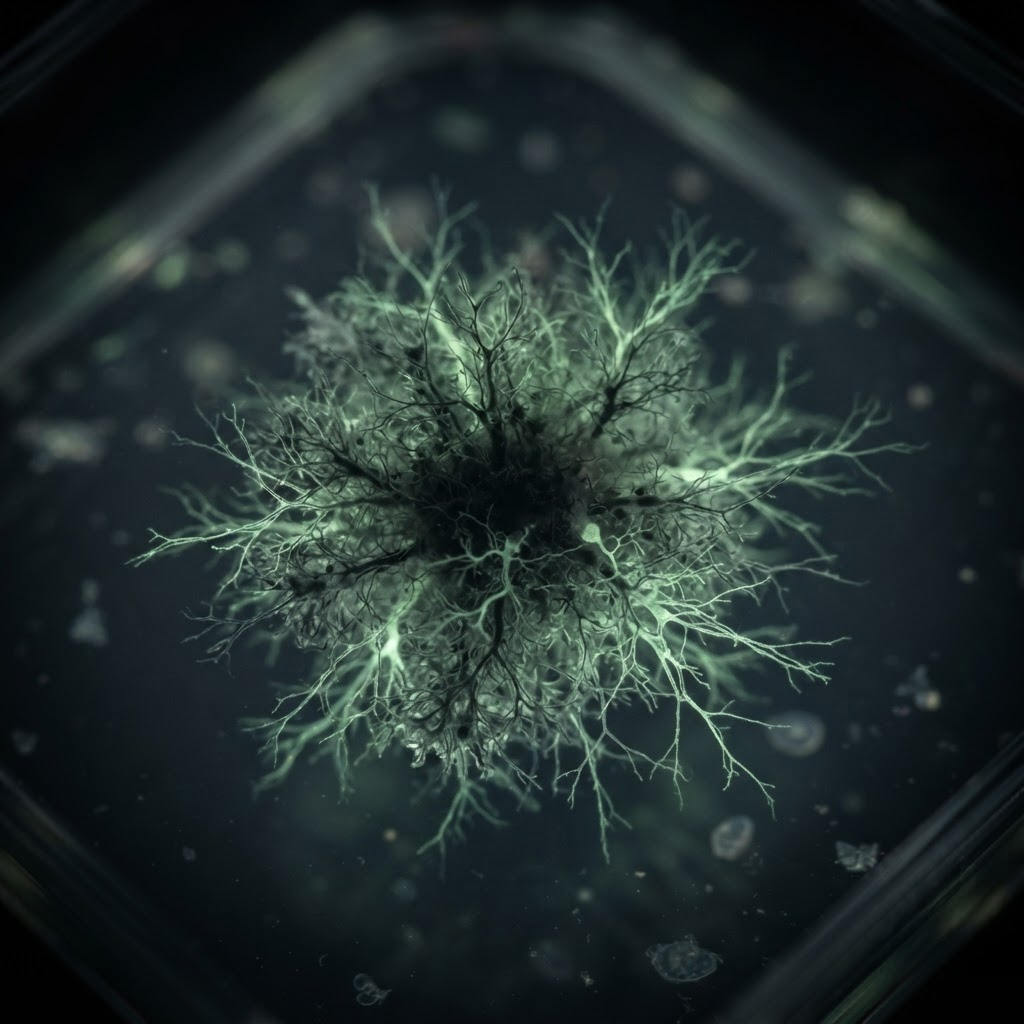
Cortical organoid recording
Through our non-profit research arm, the Heterodox Research Society, we have employed Arche for research in the areas of metascience and scientific methodology. Through the data captured by Arche, one can examine the many granular actions taken throughout the experimental process, and thus more deeply examine the scientific process itself.
We have published a preliminary technical paper titled Something Hidden in the Scientific Process, where we introduce the concept of Procedural Observability. Procedural observability treats the scientific process itself, including the often forgotten variables, deviations, and actions that occur at the bench, as something to be explored and measured in its own right.
We believe there exists a ripe frontier of new methodological possibilities in the laboratory, but exploring them first requires examining the underlying substrate upon which scientific practice actually occurs.
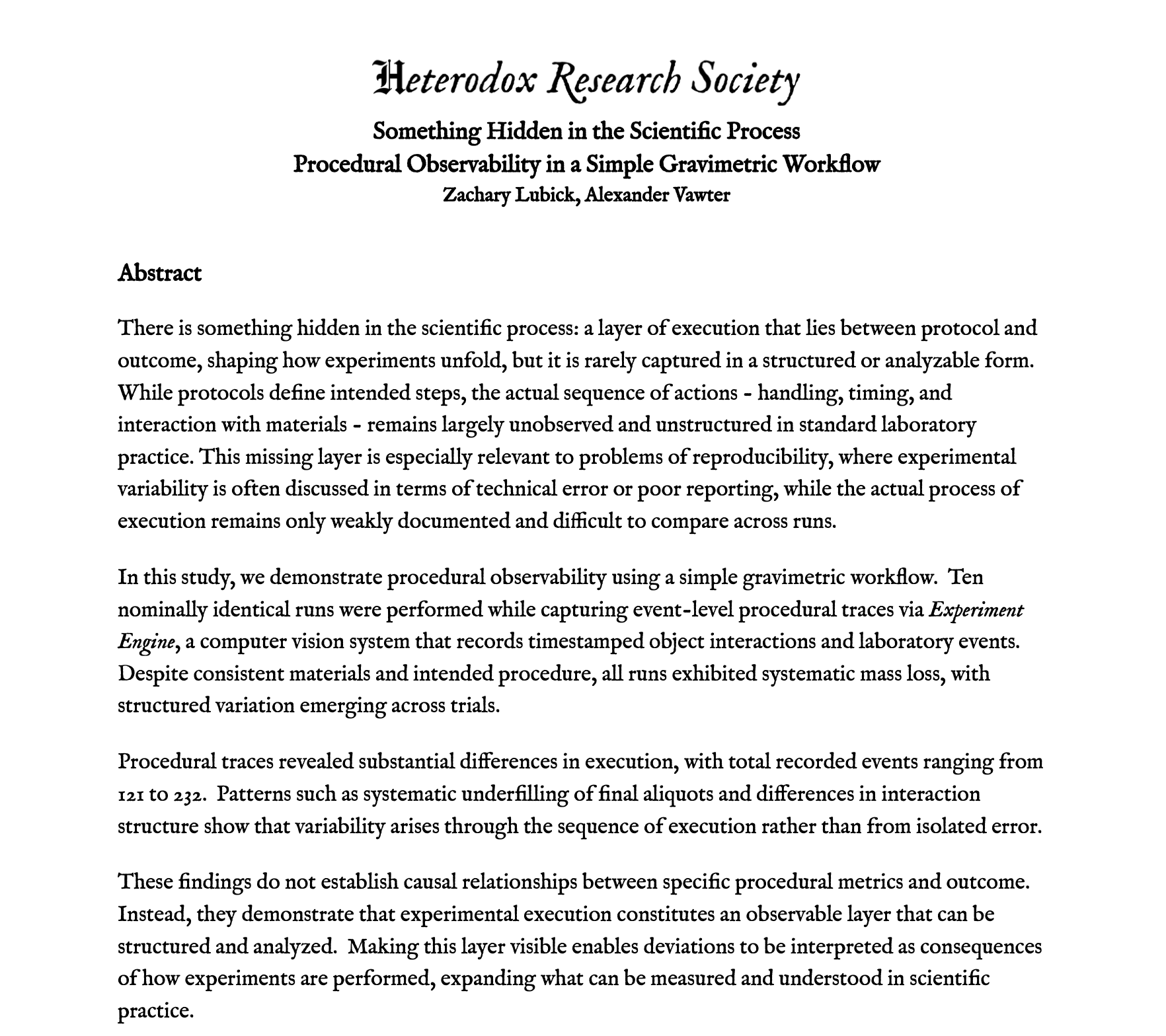
Thesis. Wet-lab experiments are fundamentally messy, and sometimes chaotic, involving varying degrees of tacit knowledge possessed by researchers. Many of the variables that ultimately shape an experiment are therefore never sufficiently captured within polished scientific artifacts such as laboratory notebooks or publications.
One practical implication is reproducibility. When substantial portions of an experiment's context are abstracted away, it can become increasingly difficult, and at times impossible, for another laboratory to faithfully reproduce the work. We see this hidden procedural layer as one contributing factor to the broader reproducibility crisis.
Yet the implications extend beyond reproducibility alone. It is precisely this abstraction of scientific output that may have gradually led us to believe science itself is a perfectly smooth, linear process of executing prescribed methodological steps. The reality inside the laboratory is something altogether different. It is messy, dynamic, uncertain, and continually shaped by human judgment.
Our work begins from the premise that this hidden procedural layer should itself be made observable. We are building systems that use cameras, sensors, computer vision, and artificial intelligence to capture the granular actions, object interactions, environmental conditions, deviations, and decisions that unfold throughout an experiment. We refer to this approach as Procedural Observability: treating the experimental process itself as something that can be systematically observed, recorded, and studied.
We also think this can serve as a foundation for human-centered augmentation research, rather than the end-to-end robotic laboratory automation approaches that have become highly popular in recent years. Through augmentation, the human remains an agent of chaos, variability, and creativity that has historically fueled the scientific enterprise.
It is our aim to reveal the true nature of scientific research, and in doing so illuminate a reality that has otherwise remained hidden.
Get started with Arche
Coming soon